
Introduction
.NET Full Stack Development involves creating both the frontend and backend parts of an
application using Microsoft .NET technologies. These applications can be web
applications, desktop applications, or even mobile applications.
A .NET full stack developer works with user interfaces, server-side logic, databases, and
APIs to build complete software solutions.
In today’s IT industry, .NET full stack developers are in high demand because they can
handle end-to-end application development.
Many beginners have a common question in their mind: Is .NET still useful today?
The answer is yes — .NET is not only useful today but will also remain important in the
future.
If you want to understand the differences between .NET Framework, .NET Core, and .NET 8, check out our
Detailed guide “Difference between .NET framework, .NET Core & .NET 8“
In this blog, we will understand what .NET full stack development is, the technologies
involved, and its career scope.
What Is .NET Full Stack Development?
.NET Full Stack Development means working on all major layers of an application:
- Frontend (User Interface)
- Backend (Business Logic)
- Database
- APIs (Application Programming Interface)
All these layers are built using technologies from the .NET ecosystem along with modern
frontend frameworks.
Technologies Used in .NET Full Stack
Programming Languages
- C#
- Visual Basic
- F#
Backend Technologies
- ASP.NET Core
- ASP.NET MVC
- ASP.NET Web API
- Web Forms (Backend as well as Frontend)
- Entity Framework Core
- ADO.NET
- Razor Pages
If you want to understand the “different between .NET Framework, .NET Core & .NET 8” check out
Our detail guide “Difference between .NET framework, .NET Core & .NET 8“
Frontend Technologies
- Angular
- React
- HTML
- CSS
- JavaScript
- Windows Forms
Databases
- SQL Server
- PostgreSQL
Technologies Used in Different Types of Applications
in .NET
1. Web Application Development
For creating web applications, the following technologies are commonly used:
- ASP.NET Core / ASP.NET MVC – Used to create backend logic and handle user
requests and responses. - ASP.NET Core Web API – Used to create REST APIs that connect frontend and
backend. - Angular or React – Used to build modern and interactive user interfaces.
- HTML, CSS, and JavaScript – Used for designing and styling web pages.
- SQL Server – Used to create database tables and store application data.
By combining these technologies, developers can create fast, secure, and scalable web
applications.
2. Desktop Application Development
For creating desktop applications, the following technologies are used:
- Windows Forms – Used to build simple desktop applications with graphical user
interfaces. - WPF (Windows Presentation Foundation) – Used to create modern and rich
desktop UI applications. - C#, F#, and Visual Basic – Programming languages used for desktop development.
- SQL Server / Local Database – Used for storing application data.
By combining these technologies, developers can build reliable desktop applications.
3] Mobile Application Development
For creating mobile applications, the following technologies are used:
- .NET MAUI / Xamarin – Used to create cross-platform mobile applications.
- C# – Used as the primary programming language.
- Web API – Used to connect mobile applications with backend services.
Using .NET MAUI, developers can create Android and iOS applications using a single
codebase.
4] API Development
For building APIs, .NET provides the following technologies:
- ASP.NET Core Web API – Used to create RESTful APIs.
- JWT Authentication – Used to secure APIs.
- Entity Framework Core / ADO.NET – Used for database operations.
- SQL Server – Used for data storage.
APIs act as a bridge between frontend applications, mobile apps, and databases.
Simple Example Architecture
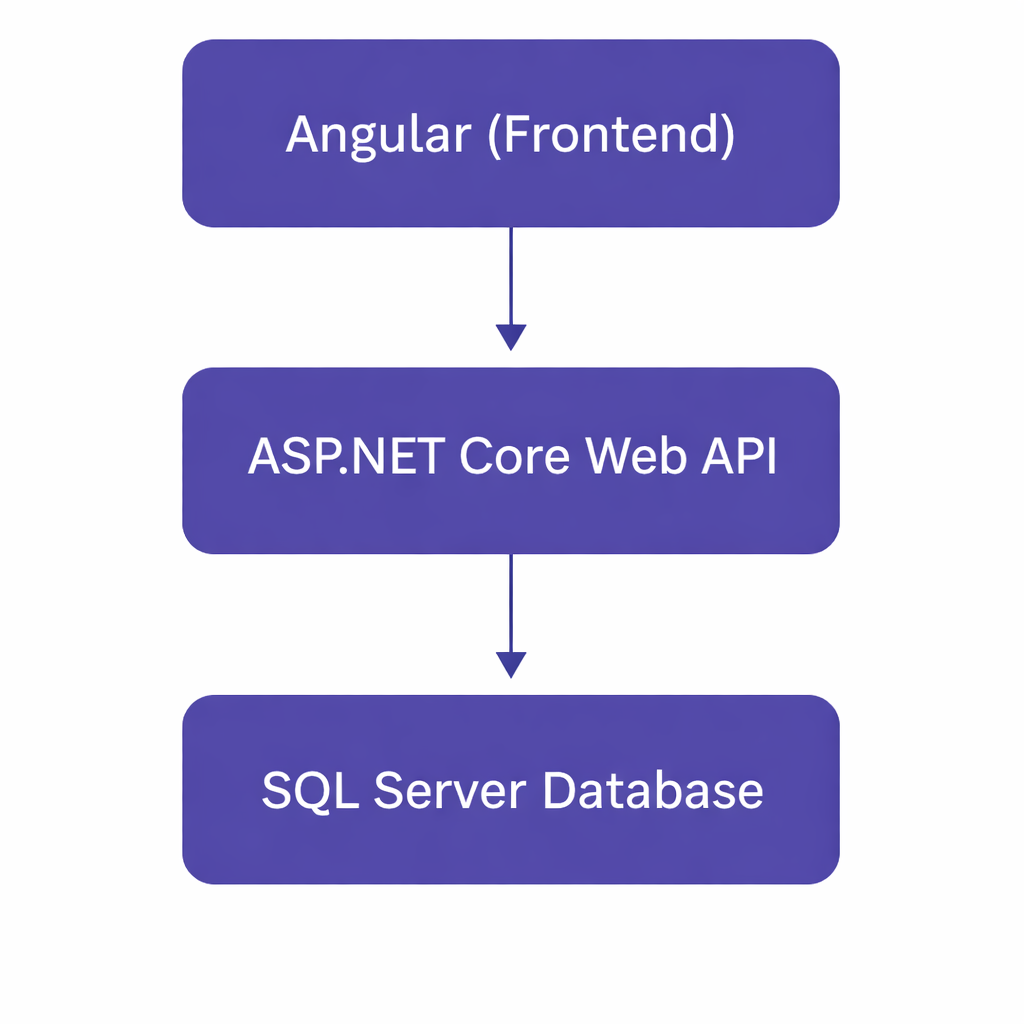
Below is a simple example of how a .NET full stack web application works:
Explanation of Each Layer
1] Angular (Frontend)
Angular handles the user interface. It displays forms, buttons, tables, and pages to the
user. When a user performs an action (such as submitting a form), Angular sends a request
to the backend API.
2] ASP.NET Core Web API (Backend)
ASP.NET Core Web API handles the business logic. It processes requests from Angular,
validates data, and communicates with the database.
3] SQL Server (Database)
SQL Server stores application data such as user details, orders, or records. The Web API
reads data from and writes data to the database.
Example Flow (Real-Life Scenario)
1.A user opens the web application in a browser.
2.Angular loads the page and displays a login form.
3. The user enters credentials and clicks Login.
4. Angular sends the request to ASP.NET Core Web API.
5. The Web API checks the data in SQL Server.
6. The API sends a response back to Angular.
7. Angular displays a success or error message to the user.
Roles and Responsibilities of a .NET Full Stack Developer
- Build user interfaces
- Create and maintain APIs
- Write backend business logic
- Design databases and write SQL queries
- Fix bugs and issues
- Deploy applications on servers
Career Scope
.NET full stack developers can work in roles such as:
- Software Developer
- Software Engineer
- Backend Developer
- Full Stack Developer
These roles are available in startups, MNCs, and enterprise-level companies.
Tips for Beginners Learning .NET Full Stack
- Start with the basics of C#
Learn C# fundamentals, object-oriented programming, and data types before
moving to frameworks. - Learn backend and frontend separately
First focus on ASP.NET Core Web API, then learn Angular or React, and later
combine both. - Practice with small projects
Build projects like a To-Do app or Employee Management System. - Understand databases
Learn SQL Server basics, table creation, and queries. - Follow official documentation
Microsoft’s .NET documentation is beginner-friendly and reliable. - Use Git and version control
Version control is an essential professional skill. - Improve debugging skills
Learning how to debug errors is as important as writing code. - Stay updated
Technologies evolve quickly, so keep learning continuously.
“Also if you are curious about different between .NET Framework, .NET Core & .NET 8 we have a
Full comparison guide Difference between .NET framework, .NET Core & .NET 8 “
Conclusion
.NET Full Stack Development is a powerful and future-proof career option. Using .NET
technologies, developers can build web applications, desktop applications, and mobile
applications. Learning .NET full stack development opens many job opportunities in the
software industry.
Frequently Asked Questions (FAQ)
Q1. Can we integrate AI into .NET applications?
Yes, AI can be integrated into .NET applications using APIs, machine learning models, and
cloud-based AI services.
Q2. Do we need Angular or React for .NET full stack development?
Angular or React is not mandatory, but they are highly recommended for building modern
and scalable frontend applications.
Q3. Is .NET currently and in the future in demand?
Yes, .NET is widely used in enterprise applications and will continue to be in demand.
Related Blogs You Might Like
- Difference between .NET Framework, .NET Core & .NET 8
- What Is ASP.NET MVC Framework? Architecture, Features, Life Cycle & Example – Learn ASP.NET MVC
- What Is Web API in .NET? Explained Simply
- Learn How to Create ASP.NET Core 8 Web API (CRUD Guide)
- How to Implement JWT Authentication in ASP.NET Core 8
- How to Implement Caching in ASP.NET Core 8 Web API (Types & Examples)
- What Is Middleware in ASP.NET Core 8? Request Pipeline Explained with Custom Middleware Example
- Azure for .NET Developers: Beginner Guide
- How to Optimize ASP.NET Core 8 Web API Performance